
How to Eat Safely Abroad When You Have Severe Food Allergies
Ordering food overseas with life-threatening food allergies or celiac disease is stressful. Here is how to communicate dietary restrictions and cross-contact rules to foreign chefs without translation mishaps.
Standing in a noisy bistro in Rome or an izakaya in Tokyo should be an exciting moment of travel. But when you or your child lives with severe peanut anaphylaxis, a tree nut allergy, or celiac disease, every meal in an unfamiliar country comes with an undercurrent of anxiety.
Language barriers make verbal explanations fragile. You might look up “I am allergic to peanuts” in a standard phrasebook, pronounce it phonetically with uncertainty, and receive a polite nod from a busy server. But did the server truly understand that even peanut oil in the dressing could trigger an emergency? Did they realize that using the same tongs for fried shrimp and fries poses a cross-contamination hazard?
Misunderstandings in a busy kitchen are rarely malicious; they are almost always linguistic. Here is a practical approach to dining safely abroad, and how structured digital allergy cards remove the guesswork.
The Hidden Failure Modes of Casual Translations
Most international travelers default to generic translation apps on their phones. While machine translation has improved for casual conversations, it carries distinct risks in commercial kitchens:
- Idiomatic Blind Spots: In many languages, the word for “nuts” refers only to walnuts or hazelnuts, while peanuts are categorized separately as legumes or groundnuts. A machine translation might omit the exact botanical distinction your immune system requires.
- Ambiguity Around Severity: Servers frequently encounter customers with mild preferences (“I don’t care for onions”) alongside customers with life-threatening conditions. If your card doesn’t clearly convey medical necessity, the kitchen may treat your request as a minor culinary adjustment rather than a safety mandate.
- Overlooking Cross-Contact: Most chefs understand omitting an ingredient from a pan. Far fewer instinctively consider cross-contact: cutting boards that held bread minutes earlier, shared pasta water, or shared deep-fryer oil.
4 Rules for Safe Dining When Traveling
Before placing any order in a foreign restaurant, seasoned allergic travelers follow four consistent safeguards:
1. Separate Medical Allergies from Dietary Preferences
Kitchens under pressure prioritize safety over lifestyle choices. If you have an anaphylactic reaction, your message must clearly say: “Consuming this food can cause severe, life-threatening illness requiring immediate medical attention.”
Reserve softer phrasing (“I prefer not to consume…”) strictly for voluntary diets so the kitchen takes medical requests with absolute seriousness.
2. Specify Kitchen Procedures, Not Just Ingredients
Instead of simply stating “No shellfish”, provide actionable kitchen boundaries:
- Please use clean cookware and fresh utensils.
- Do not cook my dish on a grill shared with shellfish.
- If you cannot guarantee a clean surface, please inform me so I can order a different meal.
3. Keep a High-Contrast Card on Hand
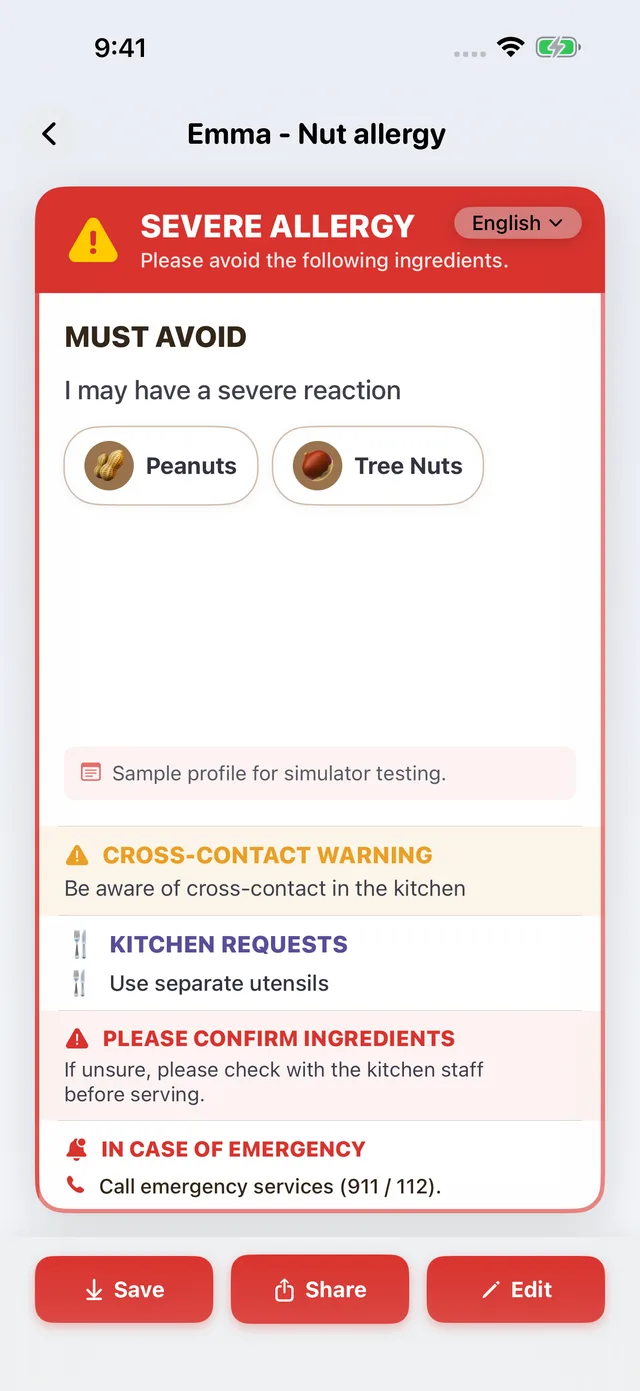
A busy chef working over an open flame cannot read dense paragraphs of text on a dim smartphone screen. Visual hierarchy matters:
- The card must feature large native typography.
- Primary allergen badges (peanuts, milk, gluten, shellfish) should be immediately recognizable at an arm’s length.
- A concise summary at the top must be legible in under three seconds.
4. Always Maintain Offline Access
Never rely on live cloud translation or cellular data in basement restaurants, rural train stops, or foreign destinations without reliable roaming. Your safety tools must reside locally on your device storage.
How AllergyCard Helps You Dine with Confidence
To solve this specific travel problem without subscription bloat or battery drain, we built AllergyCard as a quiet, offline utility for iPhone.
- Human-Vetted Culinary Translations: Rather than relying on generative AI that can hallucinate ingredients, AllergyCard uses carefully vetted culinary phrasing in over 20 languages (including French, Italian, Spanish, German, Japanese, Simplified & Traditional Chinese, Korean, Thai, and Vietnamese).
- Three Purpose-Built Tone Modes: Select between Strict Allergy (Anaphylaxis), Intolerance / Sensitivity, or Dietary Restriction so the tone matches your real physical stakes.
- Fullscreen Presentation: Tap any card to rotate into high-contrast landscape mode. Hand your phone to the server with zero confusion.
- Cross-Contamination Toggles: Explicitly check whether shared fryers, grills, or utensils must be avoided.
- Emergency Contact & Lock Screen Export: Save your card directly to your iPhone Lock Screen wallpaper or Apple Wallet so emergency contacts, ICE numbers, and Epipen instructions are accessible even if your phone remains locked.
Honest, On-Device Utility
AllergyCard runs 100% locally on your iPhone. It requires no user account, collects no health logs, and has zero advertising trackers.
- 3-Day Free Trial: Full unrestricted access to all languages and export features.
- Annual Subscription: $9.99/year.
- Lifetime License: $19.99 one-time purchase.
Explore international cuisine with confidence, not fear. Download AllergyCard on the App Store before your next trip abroad.
AllergyCard
Explain food allergies clearly when dining out or traveling abroad.

Open in the App Store